


1. Intro
In injection molding, cooling is not a side detail — it is the process. Solidifying the plastic inside the mold accounts for 50–70% of the whole cycle time. Get the cooling wrong, and you get warped parts, long cycles, and rejected product. Get it right, and you cycle faster, improve part quality, and protect the machine.
An injection molding chiller is the core of that cooling: it supplies cold water to the mold, the hydraulics, and often the barrel. This guide explains how an injection molding chiller works across the machine’s three cooling loops, how to choose one by resin and mold temperature, how to size it, and how a real plant centralizes cooling — in six clear steps.
2. Table of Contents
3. Why Injection Molding Needs a Chiller
4. How a Chiller Cools an Injection Molding Machine
5. Choosing the Chiller by Resin and Mold Temperature
6. Central Water-Cooled vs Portable Air-Cooled
7. How to Size an Injection Molding Chiller
9. FAQ: Injection Molding Chiller
3. Why Injection Molding Needs a Chiller
Cooling does three jobs at once:
- Shortens cycle time. The faster the mold reaches ejection temperature, the faster the machine cycles. Even a 20% cooling-time saving translates directly into more parts per day.
- Improves part quality. Consistent mold temperature reduces warpage, sink marks, and dimensional variation.
- Protects the machine. Hydraulic oil and the barrel both run cooler and last longer.
Industry guidance puts mold cooling water in the 10–40°C range, depending on the resin and surface finish — lower for faster cooling, higher for better surface finish.
4. How a Chiller Cools an Injection Molding Machine
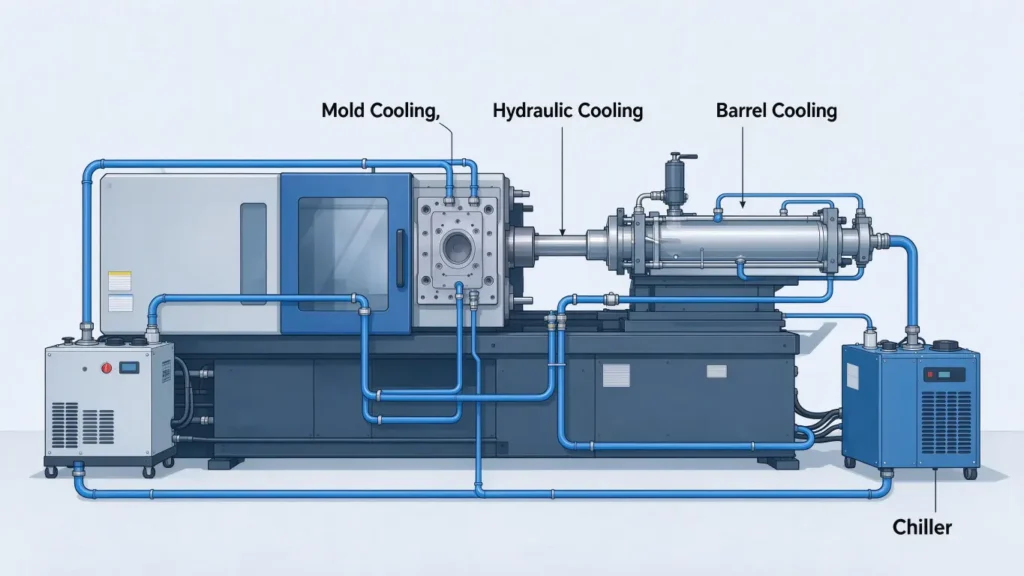
An injection molding machine actually has three separate cooling circuits, and a good chiller setup handles all of them:
- 模具冷却 — the most important. Chilled water flows through channels in the mold to solidify the part.
- Hydraulic cooling — keeps the hydraulic oil at a safe, stable temperature.
- Barrel / screw cooling — cools the feed throat zone for consistent feeding.
The diagram below shows these three loops between the injection molding machine and the chiller.
5. Choosing the Chiller by Resin and Mold Temperature
The right cooling depends on what you are molding. Different resins need different mold-water temperatures and have different cooling demands. The table below is a starting reference — confirm exact values with your material and mold engineers.
| Resin | Typical mold water temp | Cooling demand | Notes |
| PP / PE | 20–40°C | Medium | Semi-crystalline, cool reasonably fast |
| ABS | 20–40°C | Medium | General purpose, needs stable mold temp |
| PET | Cool mold, fast quench | High | Fast cooling to set the structure |
| PC | Often heated mold | Variable | Thick parts may need mold-temperature control |
6. Central Water-Cooled vs Portable Air-Cooled
There are two ways to supply that chilled water, and the choice depends on how many machines you run.
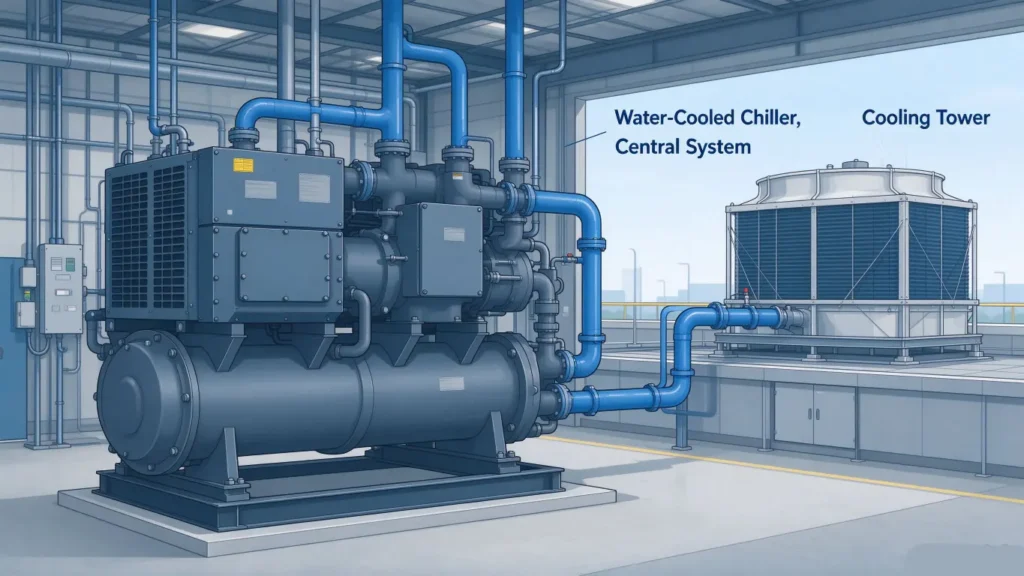
Central water-cooled system — one large chiller (plus a cooling tower) serves many machines through a chilled-water loop. Efficient and clean for a busy shop floor, but needs a tower and plumbing.
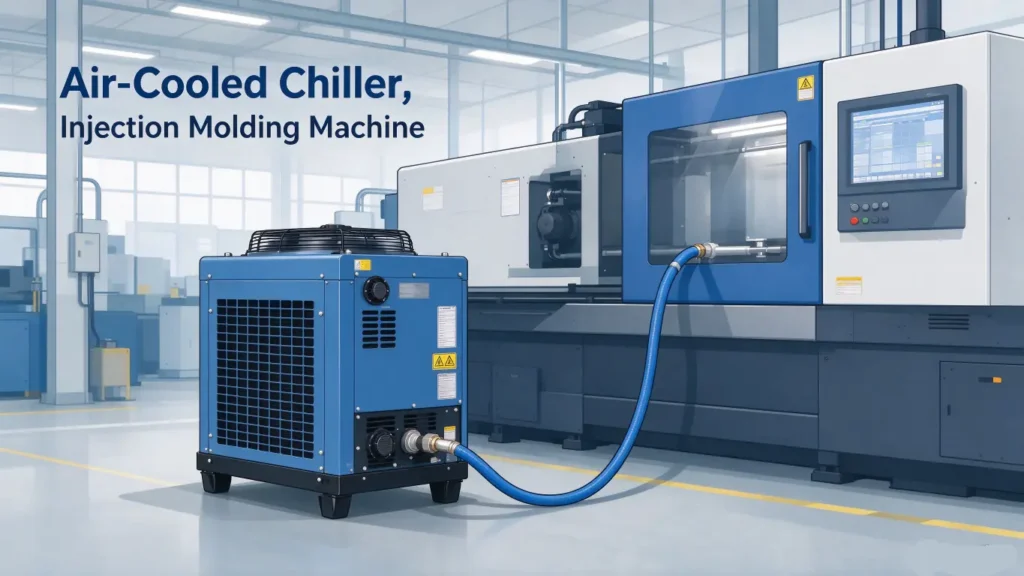
Portable air-cooled chiller — a compact unit placed beside a single machine, connected line-side. Simple, flexible, easy to move between machines, ideal for one-off or low-volume jobs.
| Factor | Central Water-Cooled | Portable Air-Cooled |
| Best for | Multiple machines, high output | Single machine, flexible setup |
| Efficiency | Higher, lower running cost | Simpler, lower upfront |
| Installation | Needs cooling tower + piping | Plug-and-play beside the machine |
| Footprint | Centralized | Sits on the factory floor |
7. How to Size an Injection Molding Chiller
Sizing comes down to your heat load. Use the standard water formula:
Cooling capacity (kW) = Flow rate (L/min) × Temperature rise (°C) × 0.0698
To estimate it:
- Measure or estimate the heat the mold must remove each cycle (material mass, melt temperature, ejection temperature, cycle time).
- Add a 20–30% safety margin.
- Confirm the chiller delivers the mold water temperature your resin needs.
- Check flow rate and pump head for your mold’s channels.
Start from the mold’s required cooling load, not from the machine’s nameplate power. When in doubt, give your supplier the cycle data and let them confirm.
See also our product about 10hp industrial water chiller
8. Real Application Case
A typical injection molding plant runs multiple machines. A central Injection Molding Chiller feeds a chilled-water loop to several molds; each mold has its own flow control, while a smaller portable air-cooled chiller serves a single line-side machine for a flexible job. This mix gives high efficiency on the main production cells and flexibility for short-run work.
9. FAQ: Injection Molding Chiller
Q1: Why is cooling 50–70% of the injection molding cycle?
Because the plastic must solidify in the mold before ejection, and that solidification takes the longest part of the cycle. Faster cooling means more parts per day.
Q2: What temperature should the mold cooling water be?
Usually 10–40°C depending on the resin and finish. Lower cools faster but can cause surface defects; higher improves gloss but lengthens the cycle.
Q3: Should I use a central chiller or a portable one?
Central water-cooled is efficient for many machines; portable air-cooled is simple and flexible for a single machine. Many plants use both.
Q4: How do I know what size injection molding chiller I need?
Calculate the heat the mold removes per cycle, add a 20–30% margin, and match the flow and temperature to your mold and resin.
Q5: Can one chiller cool the mold, hydraulics, and barrel at once?
Yes — a properly designed chiller setup serves all three loops, often with separate circuits or temperature control.
10. Conclusion
An injection molding chiller is the difference between slow, inconsistent production and fast, quality output. It cools the mold, the hydraulics, and the barrel; matched to your resin and sized to your cycle load, it shortens cycle time and protects both parts and machine.
If you are looking for a reliableInjection Molding Chiller, DAEKE provides customized cooling systems for various industries. Contact us for free technical support and quotation.