


An industrial chiller that runs clean through winter and starts tripping alarms in June is not a coincidence. Summer changes three boundary conditions at once: the ambient temperature the condenser rejects heat into goes up, the cooling load the chiller carries goes up, and the electrical components inside the control cabinet run hotter than their design point. Industrial Chiller Frequent Alarms in Summer.The chiller’s protection logic is doing exactly what it was built to do—the question is which of these three shifted far enough to cross a threshold.
This guide works through the alarm types that dominate summer downtime, in the order they actually appear on site: high-pressure trips first, then flow and temperature alarms, then overload and electrical faults. For each, it separates the root causes worth checking from the ones that waste a maintenance shift. It closes with a pre-summer checklist and an in-season routine that addresses the conditions behind most repeat alarms.
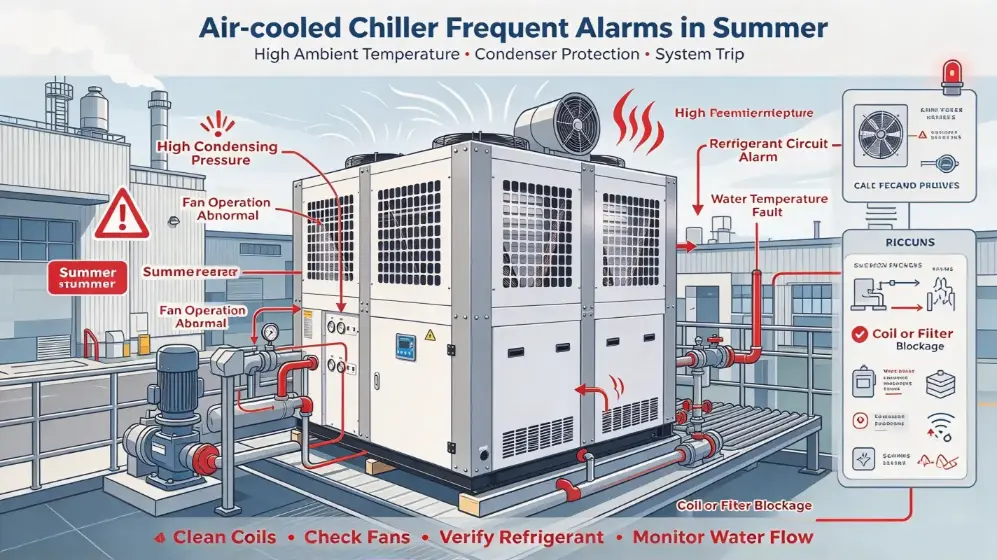
Why Summer Alarms Cluster Around Heat Rejection, Not Refrigeration
A chiller moves heat from the process loop to the environment. In summer, both ends of that transfer get harder.
On the condenser side, an air-cooled unit depends on ambient air to carry heat away. When ambient climbs past 35°C and the condenser coil carries a season of dust, the heat-transfer efficiency of the finned surface can drop by 40% or more, and discharge pressure climbs until the high-pressure switch trips. On a water-cooled unit, the cooling tower becomes the bottleneck: higher wet-bulb temperature, scaled fill, and clogged spray nozzles push cooling-water supply temperature above the 30–35°C rated window, with the same pressure consequence.
On the load side, summer production demand and higher equipment heat output push the chiller toward continuous full-load operation. The alarms that follow are not always high-pressure. A unit running flat-out at its capacity ceiling will trigger low-temperature/frost protection if setpoints were lowered carelessly, or flow alarms if the water circuit cannot keep up.
The practical takeaway: start every summer alarm investigation at the condenser and the water circuit, not at the compressor.
High-Pressure Alarms: The Dominant Summer Fault
High-pressure trips account for the largest share of summer alarm calls, and the causes narrow quickly once you separate air-cooled from water-cooled configurations.
Air-Cooled Units: The Condenser Is the First Suspect
| Symptom | Likely cause | First action |
| Discharge pressure high, condenser coil hot to touch, fan running | Dust, lint, or oil film blocking fin airflow | Clean coil with compressed air, perpendicular to fins, from inside out |
| Pressure high, one or more fans not spinning | Fan capacitor aged, motor bearing worn, blade deformed | Check fan rotation and current; replace failed motor or capacitor |
| Pressure high, unit boxed in or close to a wall | Hot discharge air re-entering the intake (hot-air recirculation) | Re-position unit or add exhaust ventilation; minimum clearance from walls and adjacent units |
| Pressure high only in late afternoon | Ambient temperature exceeding design condition | Add shading, auxiliary ventilation, or evaluate condenser upsizing for extreme-ambient sites |
A point that gets overlooked: cleaning frequency matters more than cleaning method. In dust-heavy molding or textile shops, monthly coil cleaning is a realistic interval; waiting for the annual shutdown guarantees a summer of alarms.
Water-Cooled Units: The Cooling Tower Sets the Ceiling
Water-cooled chillers rarely fail on the condenser itself first. The cooling tower fails upstream.
Cooling-water supply temperature above rated range: check tower fan operation (including reverse rotation), spray distribution, and fill condition. If the tower is undersized for the summer wet-bulb or the water circuit volume is too small, supply temperature will not recover.
Cooling-water flow insufficient: a reduced pressure differential across the evaporator and a widened temperature difference compared with commissioning data point to a clogged strainer, a partially closed valve, or a pump that no longer delivers its rated head.
Condenser tube scaling: cooling water above 30°C scales faster, and an open tower circuit admits dust and debris. Scaling reduces heat-transfer area and raises condensing pressure even when water flow looks normal on the gauge.
Refrigerant and Non-Condensable Causes
High pressure is not always a heat-rejection problem. Two refrigerant-side conditions produce the same alarm:
Overcharge after maintenance is common: suction and discharge pressures both run high, and compressor current is elevated. The correction is to recover refrigerant to the nameplate charge under rated conditions, not to keep adding gas to chase a low suction pressure. Non-condensable gas (air or nitrogen introduced during service) raises discharge pressure disproportionately relative to condensing temperature; the fix is evacuation and recharge after leak repair.
Flow and Temperature Alarms: When the Load Outruns the Water Circuit
Summer does not only stress the condenser. It changes the hydraulic behavior of the entire loop.
Water flow alarms become more frequent because higher water temperature promotes bubble formation in the circuit, and because strainers that were marginal in winter clog faster under full-load circulation. The three checks that resolve most flow alarms: pump running condition and rotation, valve position and strainer condition, and air in the loop requiring venting. A pipe diameter smaller than the chiller connection is a permanent restriction that only becomes visible at full summer flow.
Low-temperature or frost-protection alarms in summer are almost always operator-induced. Lowering the chilled-water setpoint to chase a faster cycle pushes the evaporator toward freezing when load fluctuates or makeup water is unstable. The protection trips before the compressor is damaged—the alarm is the symptom, the setpoint decision is the cause.
High leaving-water temperature (cooling insufficient) is the opposite face: the chiller is running but cannot reach setpoint. Check whether the load exceeds rated capacity, whether the temperature sensor has drifted, and whether pipe and tank insulation has been compromised. On large chilled-water tanks, a bypass arrangement may be needed to bring return water down faster during pull-down.
Overload and Electrical Alarms: Separating True Faults from Thermal Derating
Compressor and pump overload trips in summer are frequently misdiagnosed as motor failure. In many plants, the protection is tripping because the compressor is drawing more current at high condensing pressure—not because the motor winding has failed.
The sequence that avoids unnecessary parts replacement:
Verify supply quality first. Three-phase balance, terminal tightness, contactor condition, and voltage within ±5% of rated input. Summer grid load increases voltage fluctuation, and a marginal supply will trip protection on a hot afternoon while testing normal in the morning.
Check the thermal environment of the control cabinet. Contactors, overload relays, VFDs, and temperature modules derate inside a hot enclosure. A protection device that holds at 30°C cabinet temperature may nuisance-trip at 50°C. Restoring cabinet ventilation or adding forced cooling solves repeat trips that electrical testing cannot explain.
Then treat condensing pressure as the current driver. High condensing pressure raises compressor current for the same cooling output. If discharge pressure is high, the overload is a symptom of the heat-rejection problem in the previous section—not a separate electrical fault.
Only then inspect the motor itself. Winding resistance, bearing condition, and insulation are the last checks, not the first, because true motor failure is the least common of the summer overload causes.
A Troubleshooting Order That Matches How Summer Faults Actually Cascade
When a chiller alarms repeatedly in summer, the order of inspection determines how quickly it returns to service. A workable sequence:
Step 1 — Read the alarm code and record three numbers at the moment of trip: ambient temperature, condensing (discharge) pressure, and compressor current. These three values separate a heat-rejection problem from a load problem from an electrical problem before any panel is opened.
Step 2 — Inspect the heat-rejection path. Air-cooled: coil cleanliness, fan operation, clearance, recirculation. Water-cooled: tower fan, spray, fill, cooling-water supply temperature, strainer differential.
Step 3 — Inspect the water circuit. Pump current and pressure differential, valve positions, strainer condition, air venting. A flow switch that trips intermittently at full load almost always traces to one of these four.
Step 4 — Inspect the electrical enclosure. Cabinet temperature, terminal condition, protection settings. If the alarm clears after the cabinet cools and returns when it heats up, the fault is thermal derating, not component failure.
Step 5 — Only after the first four steps are clean, move to refrigerant charge and non-condensable checks.
Field experience summarized across service sources converges on one figure: roughly 80% of summer chiller alarms resolve at the ventilation, water-flow, and cleanliness level without touching the refrigeration circuit.
Prevention: A Pre-Summer Checklist and an In-Season Routine
Before the hot season starts
| Area | Action | Interval reference |
| Air-cooled condenser | Clean fins with compressed air; verify all fans spin freely | Monthly in dusty shops; at minimum before summer |
| Water-cooled condenser and tower | Descale condenser tubes; clean tower fill and spray nozzles | Annually before summer; tower inspection monthly |
| Strainers and filters | Clean or replace water filters; confirm pump delivers rated pressure differential | Monthly in season |
| Refrigerant charge | Verify subcooling and superheat against commissioning data; do not top up without diagnosis | Before summer and after any service |
| Electrical | Check three-phase balance, terminal tightness, protection relay settings, cabinet ventilation | Before summer and quarterly |
| Installation clearances | Confirm discharge air is not recirculating; add exhaust ventilation if the room exceeds 40°C | One-time review, re-check before each summer |
Industrial Chiller Frequent Alarms in Summer,During the season
Keep a simple daily log of ambient temperature, condensing pressure, and compressor current at the hottest part of the day. A upward drift in condensing pressure over two weeks is the earliest signal that coil fouling or tower degradation is accumulating—well before the first high-pressure trip. Setting an alert threshold on condensing pressure at, for example, 10% below the protection setpoint, buys time to clean rather than respond to a shutdown.
FAQ
Why does my chiller only alarm in summer, never in winter?
Because the condenser rejects heat into ambient air or tower water, and both are hotter in summer. The same coil cleanliness and tower condition that were adequate at 20°C ambient become insufficient at 38°C. The chiller is not “failing”—it is operating closer to its heat-rejection limit.
Is a high-pressure alarm a compressor problem?
In most summer cases, no. High-pressure protection responds to condensing pressure, which is determined primarily by heat rejection at the condenser. Compressor wear is a possible but far less common cause, and it should be investigated only after condenser, tower, and refrigerant charge have been verified.
Can I just reset the alarm and keep running?
Resetting without correcting the cause leads to repeat trips and shortens compressor life through repeated high-current starts. If the same alarm returns within a shift, stop resetting and walk the troubleshooting sequence.
How often should the condenser be cleaned in a dusty production environment?
Monthly during production season is a practical baseline for shops with high dust, lint, or oil mist. A coil that looks “mostly clean” can still carry enough surface film to raise condensing pressure several degrees.
What voltage range is acceptable for a chiller in summer?
Most industrial chillers specify supply voltage within ±5% of rated input. Summer grid load increases fluctuation, and a supply that measures normal at low-load hours can sag during peak afternoon demand—enough to trip protection on startup.
When should I call a service technician instead of troubleshooting myself?
If the first four inspection steps—heat rejection, water flow, electrical supply, cabinet thermal condition—are clean and the alarm persists, or if refrigerant-side diagnosis is required. Do not open the refrigeration circuit or adjust protection setpoints without the instrumented data to justify the change.