


1. Intro
Salmon is one of the most perishable seafood products in the world. From the moment it is harvested, temperature control decides freshness, shelf life, and food safety. Salmon cooling and washing is therefore a critical step in every processing line: the fish must be chilled quickly and washed in clean, cold water to slow bacterial growth and maintain quality.
A 40 HP industrial chiller is an excellent, proven solution for this application. It supplies low-temperature water through a glycol loop and a plate heat exchanger, cooling the wash tank and the salmon inside to a safe temperature. This guide explains why salmon cooling and washing matters, how a 40 HP chiller system works, what capacity it can handle, and a 6-step method to design your own line.
2. Table of Contents
3. Why Salmon Cooling & Washing Matters
4. The Salmon Cooling & Washing System: 40 HP Chiller + Glycol Loop
6. Capacity Check: What a 40 HP Chiller Can Handle
7. How to Design Your Salmon Cooling & Washing Line in 6 Steps
8. FAQ: Salmon Cooling & Washing
3. Why Salmon cooling and washing Matters
Salmon quality and safety depend on keeping the fish cold from harvest to processing. High temperature causes three serious problems:
- Rapid spoilage. Warm salmon spoils quickly as enzymes and bacteria multiply, reducing shelf life and value.
- Microbial risk. Pathogens such as Listeria monocytogenes can grow on cold-smoked and raw salmon. Food authorities recommend HACCP systems and strict temperature control to manage this risk — see the Centre for Food Safety guidance on cold-smoked salmon.
- Poor washing. Cleaning must happen in cold water; warm wash water becomes a breeding ground rather than a cleaning medium.
Regulators consistently advise keeping seafood cold throughout processing — the Australian/New Zealand food authority, for example, emphasizes “keep it cold” as the first rule for raw fish handling
This is why salmon cooling and washing with a reliable chiller is not optional in a professional facility.
4. The Salmon cooling and washing System: 40 HP Chiller + Glycol Loop
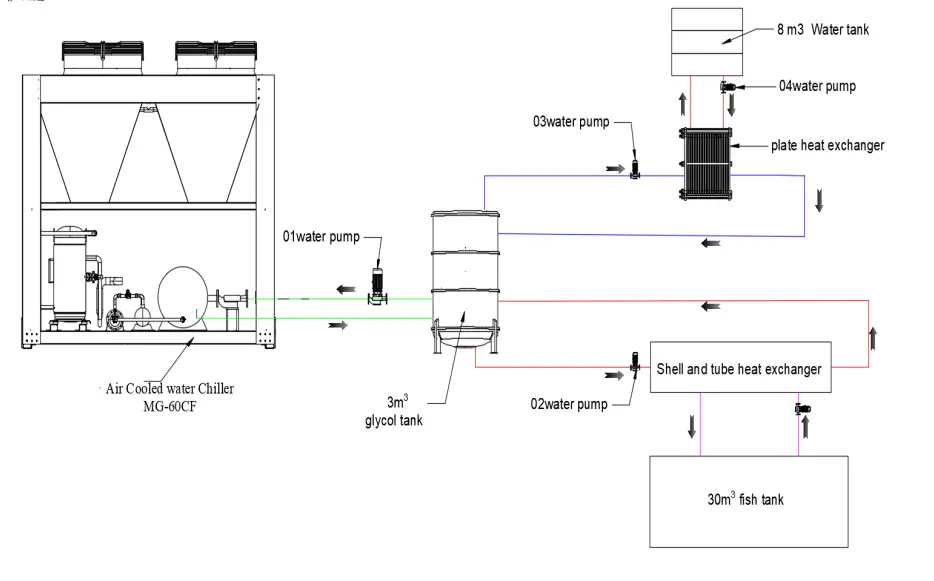
The recommended system for a salmon processing line has four main parts working together:
- 40 HP industrial chiller — produces low-temperature cooling, typically running a glycol loop to avoid freezing and corrosion issues.
- Glycol storage tank — buffers the chilled glycol, smoothing load fluctuations.
- Plate heat exchanger — transfers cold from the glycol side to the clean water side without mixing the two fluids (a food-safety advantage).
- Cold wash / chill tank — where salmon is cooled and washed in low-temperature water.
The diagram below shows this layout: the chiller cools a glycol loop, which cools the wash water through a plate heat exchanger, keeping the salmon tank at the target temperature.
Why use a glycol loop and heat exchanger?Salmon Cooling and Washing
- No cross-contamination. The glycol never touches the salmon; a plate heat exchanger separates the fluids cleanly.
- Lower, stable temperatures. Glycol allows the chiller to run at temperatures below freezing without the water freezing in the evaporator.
- Flexible layout. The chiller can sit outside or at a distance, while the wash tanks are inside the clean processing area.
5. How the Salmon Cooling and Washing System Works
The process follows a continuous circulation loop:
- The 40 HP chiller cools the glycol in a storage tank to the set temperature.
- A pump circulates the cold glycol through the plate heat exchanger.
- On the other side of the exchanger, clean process water is cooled without mixing with the glycol.
- The cold water feeds the Salmon cooling and washing tank, where salmon is cooled and cleaned.
- Warmer water returns to the heat exchanger to be re-cooled, and the cycle continues.
This arrangement keeps the salmon at a low, stable temperature throughout cleaning — exactly what salmon cooling and washing requires for quality and safety.
6. Capacity Check: What a 40 HP Chiller Can Handle
A 40 HP chiller delivers roughly 120 kW of cooling at standard conditions (capacity varies by manufacturer and operating point — confirm with the chiller’s nameplate data). On the water side, the cooling capacity is determined by:
Cooling water flow (L/min) = Capacity (kW) ÷ (ΔT °C × 0.0698)
Using this check, a 40 HP (≈120 kW) chiller can cool roughly:
| Water temperature rise (ΔT) | Handled flow rate |
| 3°C | ≈ 573 L/min (34.4 m³/h) |
| 5°C | ≈ 344 L/min (20.6 m³/h) |
| 8°C | ≈ 215 L/min (12.9 m³/h) |
For a salmon wash line that needs low-temperature water (typically 2–8°C), this capacity supports a meaningful wash-water flow while holding the tank cold. These are engineering estimates — the exact figure depends on your line’s flow, inlet temperature, batch load, and ambient conditions, and should be confirmed with your engineer.
7. How to Design Your Salmon Cooling and Washing Line in 6 Steps
Use this six-step method to design a 40 HP chiller system for your own salmon processing line.
Step 1 — Define the process requirement
Determine the wash/chill water temperature you need (typically 2–8°C for salmon), the water flow rate, and the peak batch load of fish to be chilled.
Step 2 — Calculate the cooling load
Sum the heat gains: incoming fish temperature and mass, wash-water make-up, heat from the environment, and equipment. This gives your required capacity.
Step 3 — Select the chiller
Choose a chiller (here, 40 HP ≈ 120 kW) that meets the load with a safety margin, and confirm it can deliver water at your required temperature in your ambient conditions.
Step 4 — Design the glycol and heat-exchange loop
Size the glycol loop, storage tank, and plate heat exchanger so the chilled water reaches the wash tank at the right temperature and flow.
Step 5 — Lay out the wash / chill tank
Size the tank for your batch throughput and ensure good water circulation so all salmon cool evenly. Position the tank inside the clean processing area.
Step 6 — Add controls and food-safety safeguards
Use a controller to hold the water temperature and add monitoring/alarms. Follow HACCP principles and use food-grade, cleanable materials.

8. FAQ: Salmon Cooling and Washing
Q1: What temperature should salmon wash and chill water be?
Typically 2–8°C. Keeping the fish near ice temperature slows bacterial growth and preserves quality. The exact value depends on your process and HACCP plan.
Q2: Why use a 40 HP chiller instead of ice?
A chiller provides a continuous, stable supply of cold water without the cost, handling, and temperature swings of buying and replenishing ice. It is easier to control and scale.
Q3: Why a glycol loop and plate heat exchanger?
Glycol lets the chiller run at low temperatures without freezing, and the plate heat exchanger keeps glycol separate from the food-contact water — a clean, food-safe design.
Q4: How much cooling can a 40 HP chiller provide?
Roughly 120 kW at standard conditions, which supports roughly 344 L/min of water cooled through a 5°C temperature rise. Confirm with your engineer using your real load.
Q5: Is salmon cooling and washing required for food safety?
Yes. Temperature control is a critical control point in seafood HACCP plans to limit pathogen growth and spoilage. Cold, clean wash water is part of good manufacturing practice.
Q6: Can the system be expanded?
Yes. Because the chiller feeds a central chilled loop, you can add more heat exchangers and wash tanks and increase chiller capacity as production grows.
9. Conclusion
Salmon cooling and washing is a critical step in every processing line, and a 40 HP industrial chiller is a proven, food-safe way to do it. The chiller cools a glycol loop; a plate heat exchanger transfers that cold to clean wash water; and the salmon is held at a low, stable temperature through cleaning. The approach is reliable, hygienic, and easy to scale.
If you are looking for a reliable seafood cooling solution, DAEKE provides customized chillers and cooling systems for the food industry. Contact us for free technical support and quotation.