


1. Intro
A laser is a high-energy tool, and high energy means heat. Whether it is cutting steel, welding parts, or marking products, the laser source generates significant heat that, if not removed, degrades beam quality, shortens the life of expensive optics, and causes sudden downtime. That is why Laser Equipment Cooling is not optional — it is a critical part of the machine.
This guide explains why lasers need cooling, how a laser chiller removes that heat, the specifications that actually determine performance, and how to choose the right cooling system for your cutting, welding, or marking application. By the end, you will know exactly what to ask before you buy.
2. Table of Contents
- 1. Intro
- 2. Table of Contents
- 3. Why Do Lasers Need Cooling?
- 4. How Does Laser Cooling Work?
- 5. Key Specifications of a Laser Chiller
- 6. Laser Chiller Types
- 7. Laser Cooling Applications
- 8. How to Choose a Laser Chiller
- 9. Frequently Asked Questions (FAQ)
- 10. Conclusion
3. Why Do Lasers Need Cooling?
Laser sources are not 100% efficient. A typical fiber or CO₂ laser converts only a fraction of its electrical input into light; the rest is released as heat inside the laser resonator and power supply. If that heat is allowed to build up, it causes:
- Beam quality degradation — the laser output becomes unstable and less precise.
- Damage to optics — lenses and mirrors overheat and fail prematurely.
- Frequency / wavelength drift — especially critical for laser sources used in precision work.
- Unexpected shutdowns — thermal protection triggers and stops production.
In short, reliable laser cooling protects both product quality and machine availability. It is the difference between consistent output and costly interruptions.
4. How Does Laser Cooling Work?
Most industrial lasers are cooled with a closed-loop water cooling system. A laser chiller continuously pumps chilled water through the laser head, absorbs the heat, cools the water again, and recirculates it. The diagram below shows this loop.
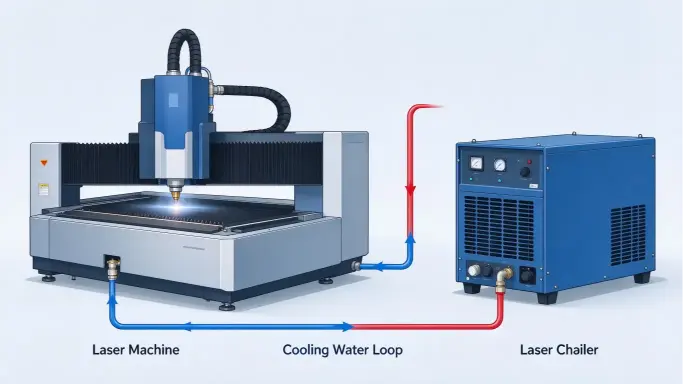
The cycle has three practical stages:
- Chilled water delivery. The laser chiller sends water at the required temperature and flow to the laser source.
- Heat absorption. The cooling water passes through the laser head (and optics), absorbing heat and rising in temperature.
- Heat rejection. The warmed water returns to the chiller, where the refrigeration system removes the heat and re-chills it for the next pass.
Two types of cooling loops exist in laser systems:
- Single-loop(direct cooling) — chilled water goes directly through the laser. Simple and common.
- Double-loop(with a heat exchanger) — a clean internal loop cools the laser while a separate industrial loop rejects heat to ambient air. Recommended for environments with dirty or hard water, because it protects the expensive laser optics from scale and contamination.
Key point: For laser cooling, water quality and cleanliness matter just as much as temperature. Scale, corrosion, and bacteria inside the laser head will shorten its life dramatically.
5. Key Specifications of a Laser Chiller
When comparing laser chillers, focus on these specifications — they determine whether the unit protects your laser correctly.
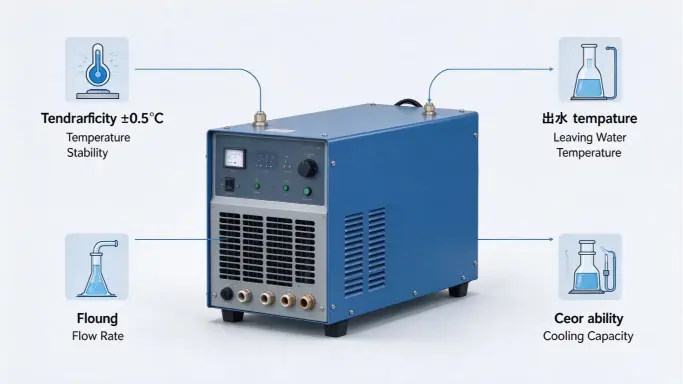
5.1 Cooling Capacity(kW)
The amount of heat the chiller can remove. Your laser manufacturer provides a recommended cooling capacity based on the laser’s heat output. Always meet or slightly exceed this figure.
5.2 Temperature Stability(±0.1°C / ±0.5°C / ±1°C)
This is the most important specification for lasers. Laser sources need a stable water temperature — not just a fixed target. High-end lasers require stability of ±0.5°C or better; precision applications may need ±0.1°C.
5.3 Leaving Water Temperature(Setpoint)
The temperature the chiller delivers to the laser, usually set between 15°C and 25°C depending on the laser and the environment. Confirm your laser’s recommended operating temperature.
5.4 Flow Rate(L/min)
Enough water must circulate to carry the heat away. Insufficient flow causes hot spots and can trigger the laser’s thermal protection.
5.5 Pump and Water Quality
The pump must deliver the required flow at the required pressure. Water treatment (filtration, deionization) protects the laser optics. Choose materials compatible with your water chemistry.
5.6 Ambient Operating Range
Air-cooled laser chillers become less efficient in hot workshops. Check the unit’s performance at your actual ambient temperature.
6. Laser Chiller Types
6.1 By Laser Type
- Fiber laser chillers — used for fiber laser cutting and welding. Require tight temperature stability and precise flow control to protect the fiber laser source.
- CO₂ laser chillers — for CO₂ lasers (cutting, engraving). Need high cooling capacity and stable temperature.
- Diode / semiconductor laser chillers — for diode-pumped and semiconductor lasers, often requiring very stable low temperatures.
6.2 Air-Cooled vs Water-Cooled Laser Chillers
| Factor | Air-Cooled Laser Chiller | Water-Cooled Laser Chiller |
| Heat rejection | To ambient air | To a cooling tower / external water loop |
| Water consumption | None | Requires water supply and treatment |
| Installation | Self-contained, simpler | Needs cooling tower and more piping |
| Best for | Smaller lasers, moderate climates, quick setup | High-power lasers, hot climates, large plants |
[LINK — Laser Chiller product page]
Rule of thumb: Most single laser machines up to medium power are well served by an air-cooled laser chiller. Very high-power or multiple-laser lines in hot facilities usually justify a water-cooled configuration.
7. Laser Cooling Applications
Laser cooling protects every process where a laser source runs continuously. The illustration shows a central laser chiller serving multiple laser stations in one plant.
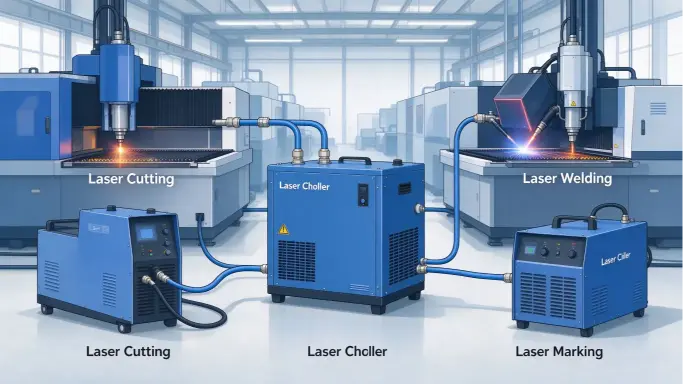
- Laser cutting — keeps the laser source stable for clean, precise cuts on metal, sheet, and tube.
- Laser welding — protects the source during high-duty welding cycles.
- Laser marking / engraving — stable temperature for consistent, high-resolution marks.
- Medical & aesthetic lasers — precise cooling for diagnostic and treatment equipment.
- Laser communication & optical systems — temperature control for sensitive optical components.
Whatever the process, the principle is the same: remove heat reliably so the laser performs consistently.
8. How to Choose a Laser Chiller
Follow these steps to select the right laser cooling system.
Step 1 — Match the cooling capacity
Get the recommended cooling capacity and flow rate from your laser manufacturer. This is your starting requirement.
Step 2 — Confirm the temperature stability
Match the chiller’s temperature stability to your laser’s requirement. Precision lasers need ±0.5°C or better — do not compromise here.
Step 3 — Decide the loop type
Choose double-loop if your water supply is hard or dirty, or if the laser manufacturer specifies it. Choose single-loop for clean water and simpler setups.
Step 4 — Check the ambient conditions
If your workshop is hot, verify the chiller’s capacity at your actual ambient temperature, not at an ideal 25°C rating.
Step 5 — Verify controls and monitoring
Modern laser chillers offer digital controllers, temperature alarms, and remote monitoring (Modbus, etc.). Integration with your machine’s control system prevents silent overheating.
Step 6 — Compare lifecycle cost
Efficiency, spare-parts availability, and after-sales support matter more than the purchase price for a unit that runs continuously.
Also verify before signing: water pump material, heat-exchanger type, refrigerant compliance, and the exact temperature stability in real operating conditions.
9. Frequently Asked Questions (FAQ)
Q1: Why does a laser need a chiller and not just a fan?
A laser source generates concentrated heat that fans cannot remove fast enough to keep the optics stable. Water cooling removes heat far more efficiently and holds a stable temperature.
Q2: What temperature should a laser chiller run at?
It depends on your laser. Most are set between 15°C and 25°C, and must be held stable within the laser’s tolerance (often ±0.5°C or better).
Q3: How do I know what size laser chiller I need?
Use the cooling capacity and flow rate recommended by your laser manufacturer, then confirm the chiller delivers it at your ambient temperature with the required stability.
Q4: Is an air-cooled or water-cooled laser chiller better?
Air-cooled is simpler and self-contained, ideal for single machines in moderate climates. Water-cooled is better for high power, hot climates, and large installations.
Q5: Why does water quality matter for laser cooling?
Hard or dirty water causes scale and corrosion inside the laser head, damaging expensive optics. Use treated water and, ideally, a double-loop system.
Q6: How long does a laser chiller last?
With regular maintenance and good water quality, 15 years or more is realistic.
10. Conclusion
Laser cooling is the invisible foundation of every reliable cutting, welding, and marking line. Choosing the right laser chiller comes down to matching cooling capacity, holding tight temperature stability, protecting optics with clean water, and planning for your real ambient conditions. Work through the six steps above and you will protect both your laser’s performance and its lifetime.
If you are looking for a reliable laser cooling solution, DAEKE provides customized laser chillers for various industries. Contact us for free technical support and quotation.