
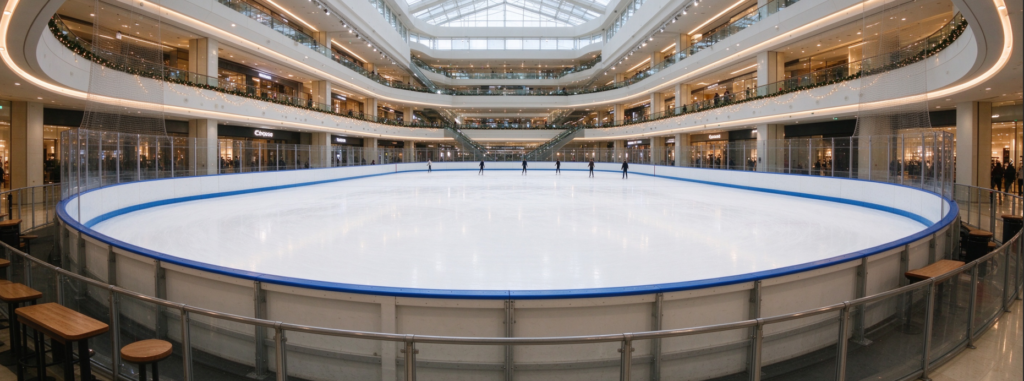
What Is An Ice Rink?
An ice rink is a dedicated venue for ice sports, including ice skating, ice hockey, figure skating, speed skating, curling and other ice-based activities. Ice rinks are classified in different ways according to usage scenarios and construction types.
An indoor ice rink is built inside a building. Its temperature and humidity are controlled by a professional cooling system, so the ice surface stays stable and is barely affected by outside weather. It can run all year round for commercial or competitive use.
An outdoor ice rink is constructed in open-air spaces. It has no mechanical refrigeration system and fully relies on natural low ambient temperature. It is heavily weather-dependent and cannot sustain ice for long periods. Most outdoor ice rinks are seasonal projects.
Working Principle of Ice Rink Cooling System
Beneath the ice surface, there is a large network of embedded metal pipes. Low-temperature glycol solution (or brine) at around -15°C circulates inside these pipes to freeze the ground water and form a solid ice sheet, and continuously remove heat to prevent the ice from melting.
A complete ice rink cooling system includes these core components:
- Water chiller: The heart of the whole system, usually screw type water chiller, available in air cooled and water cooled models.
- Large stainless steel buffer tank
- Two independent circulation pipelines
- Loop 1: Fluid circulation between buffer tank and water chiller
- Loop 2: Fluid circulation between buffer tank and underground ice rink piping
Important reminder: If brine (salt water) is selected as the coolant, all pipes, pumps and evaporators must use anti-corrosion materials. Otherwise, salt corrosion will quickly damage the equipment and cause fluid leakage.
Core Factors to Select the Right Ice Rink Water Chiller
Selecting an ice rink water chiller is not only about picking a big machine. You need to evaluate multiple parameters before making the final decision.
1.Calculate Required Cooling Capacity
Cooling capacity is the most critical parameter. It is calculated based on the ice rink area, indoor ambient temperature, target ice temperature, heat loss from roof, walls and audience.
For a standard indoor ice hockey rink, the required cooling load is much higher than a small commercial recreational rink. Too small chiller cannot keep ice frozen; oversized chiller wastes electricity and increases investment cost.
2.Choose Air-Cooled or Water-Cooled Screw Chiller
Screw water chillers are the mainstream choice for ice rink projects.
- Air cooled screw chiller: No cooling tower required, easy installation, less on-site pipe work. Suitable for projects with limited space or inconvenient water supply.
- Water cooled screw chiller: Higher energy efficiency for large continuous operation. It needs a cooling tower and water pump, better for big professional ice hockey rinks running 24/7.
3.Coolant Medium Selection: Glycol or Brine
Most ice rink projects use glycol solution as the circulating medium. Glycol has low corrosion to carbon steel pipes, which reduces maintenance cost.
Brine is cheaper but highly corrosive. If you pick brine, all wetted parts of chiller and piping must adopt anti-corrosion treatment or stainless steel material.
4.ower Supply & Working Environment
You need to confirm local industrial voltage, frequency and maximum available power before ordering. For overseas projects, power specification difference is a common reason for equipment failure. Also check ambient temperature, altitude and ventilation conditions at the installation site.
Maintenance Tips for Ice Rink Water Chiller
Ice rink chillers run continuously for months, so regular maintenance is essential to avoid unexpected shutdown and ice melting.
- Check glycol concentration and fluid level every month.
- Clean condenser regularly to keep heat exchange efficiency.
- Inspect pumps, valves and pipe joints for leakage.
- Monitor running temperature and pressure data daily.
- Do annual overhaul before peak season.
FAQ
1.What type of chiller is best for an ice rink?
Screw low-temperature water chiller is the most widely used option for ice rinks. Air cooled screw chillers are popular for medium-size commercial ice rinks. Water cooled screw chillers are preferred for large professional ice hockey stadiums.
2.Choose Air-Cooled or Water-Cooled Screw Chiller
Screw water chillers are the mainstream choice for ice rink projects.
- Air cooled screw chiller: No cooling tower required, easy installation, less on-site pipe work. Suitable for projects with limited space or inconvenient water supply.
- Water cooled screw chiller: Higher energy efficiency for large continuous operation. It needs a cooling tower and water pump, better for big professional ice hockey rinks running 24/7.
3.Is glycol mandatory for ice rink cooling?
Not mandatory. Brine is an alternative, but glycol is recommended for most projects because of its lower corrosion risk and stable performance at sub-zero temperature.
Conclusion
The water chiller determines the stability and operating cost of your ice rink. Before purchasing, confirm ice rink type, ice area, cooling capacity demand, site water & power condition and coolant type. Our team provides customized low-temperature chiller solutions for commercial and professional ice rink projects worldwide. Contact us to get your cooling calculation and quotation.